
1. For a reader encountering Delal Tekin and your work for the first time, could you tell us a little about yourself? How did your relationship with art begin, and what keeps you painting today?
My relationship with art was not something that began suddenly; it was a process that naturally took shape over time as my interest developed. From childhood onwards, painting was not merely a hobby for me; it became a natural way of expressing myself. My painting journey began with the pictures I drew on the walls of the house where I lived during my childhood.
Over time, I realised how strong a need this was for me. By need, I mean that it was a means of transferring my imagination and thoughts outward in some way. My education in the Painting Department of the Faculty of Fine Arts at Anadolu University enabled me to transform this interest into a more conscious practice of production. There, I also came to understand more clearly that what I learned technically was not merely about visual representation, but also about thinking, questioning, and creating one’s own language.
What keeps me painting today is actually still the same fundamental need: to transform the things I want to say into a visual language. Sometimes a feeling, sometimes a body, sometimes a colour, or simply an image that forms in my mind drives me to create. Every work has been an ongoing process of discovery for me, through which I try to understand and express myself.
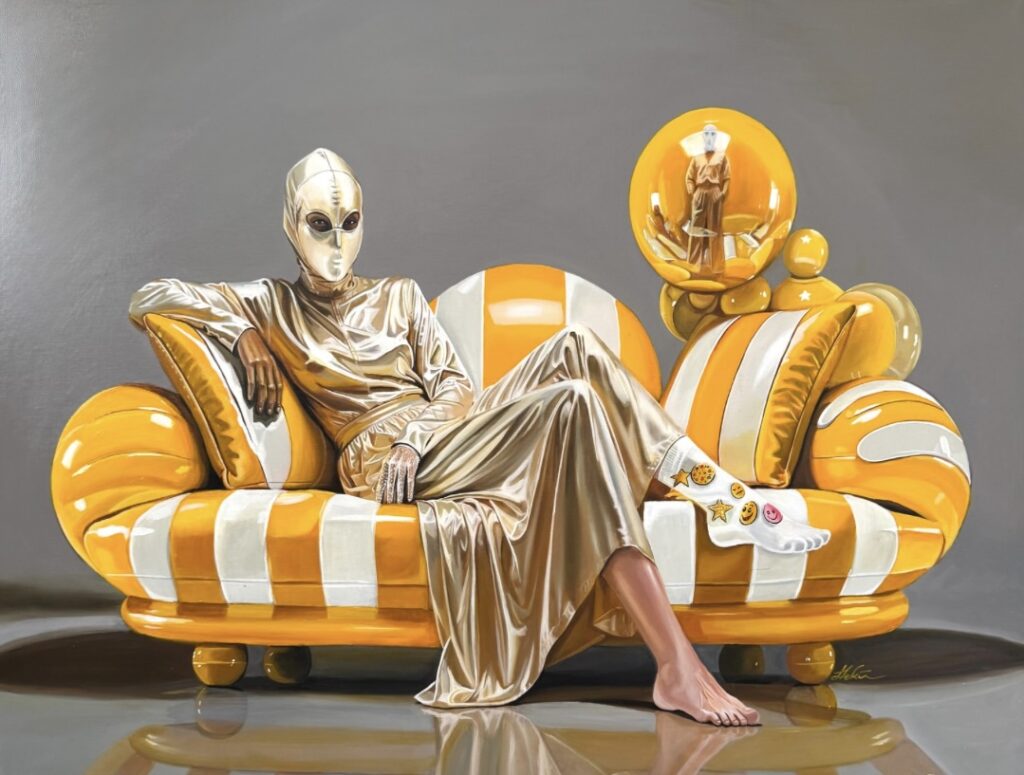
“I Don’t Know Who I Am Unless Someone Asks” 2026, Acrylic on canvas, 70×90 cm
2. When you think about how your relationship with art has changed over time, what difference do you see between where you are looking at your practice today and where you began? What encounters have been most important in transforming your perspective and the way you work?
My relationship with art has changed considerably over time, both technically and conceptually. When I first started, I mostly followed my instincts while painting, trying to directly transfer what I saw or imagined. Technically, as I developed myself in colour, light, composition, anatomy, surface, and material, my approach to painting also changed. At first, I tried to apply the techniques I learned correctly; today, I use technique in the service of the idea I want to express.
In terms of ideas, the biggest change for me was realising that painting is not simply about creating an image. In the early period, I thought more about “what can I draw?”, whereas today the questions “why am I doing this, and what does this image say to me?” are more decisive. Elements such as the figure, body, face, fabric, colour, and nature have, over time, ceased to be merely aesthetic elements for me and become a language that carries my thoughts.
When I look at my work today, I see that the excitement of painting I had at the beginning is still the same, but my perspective has become much more conscious. With the technical knowledge and experience I have gained over time, I am not simply trying to turn things into visuals; I am telling something. Technically I am freer, while conceptually I am at a more questioning point.
The most important thing that transformed my perspective and way of working during this process has been a richer form of expression that emerged from the combination of the art and artistic perspectives of other artists with the emotions I have within myself. Another important encounter was looking back at my own work over time. When I place my older works next to my current ones, I see that my artistic practice has changed along with me. I think what has transformed me most is continuing to learn, experiment, and question my own production.
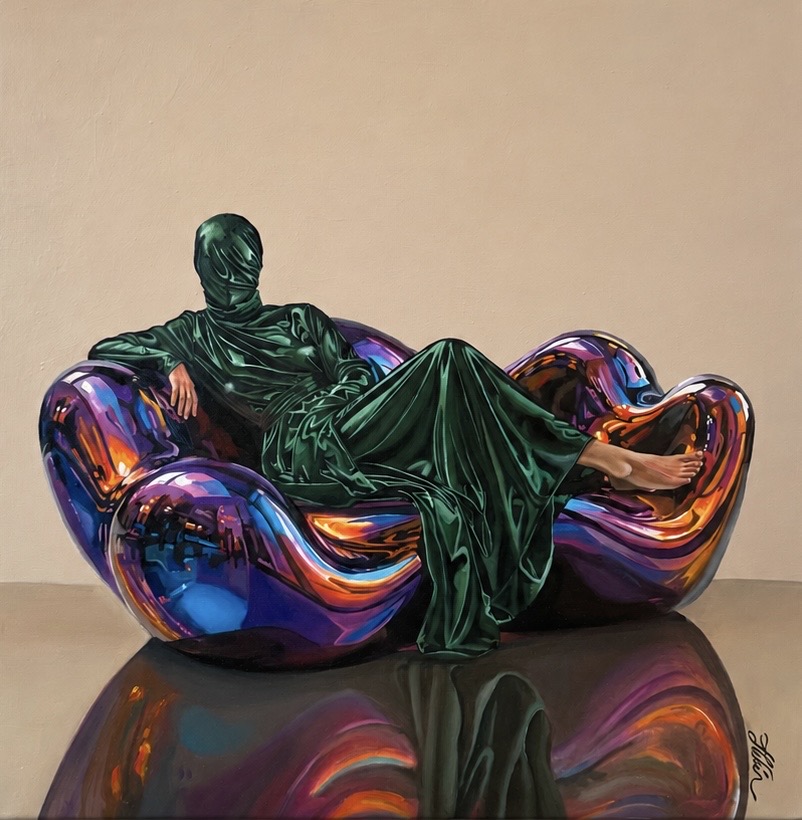
“A Solitary Splendor” 2026, Acrylic on canvas, 50 × 50 cm
3. We see a distinct language of the figure emerging in your paintings, one that has gradually become associated with your work. What were you seeking as you developed this language, and looking back today, how do you connect your initial search with your current practice?
The figurative language that has become distinct in my paintings over time was not something I decided on all at once. I began to see the figure not as a human body, but as a field of expression carrying emotions and thoughts. In particular, the posture of the body and the face being in the background, covered, or partially visible gradually became important means of expression for me.
Today, when creating a figure, I try to establish a balance between anatomical reality and my own interpretation. Colour, fabric, surface, and the figure’s position within the space also become parts of this language.
Looking back, I see a strong connection between my initial search and my current practice. What has changed is essentially that my way of looking at the figure has deepened. The figure I initially simply depicted has now become an area in which I think about visibility, identity, the body, and the ways in which people express themselves. In other words, I now consciously investigate the things I initially did intuitively and make them part of my own visual language.
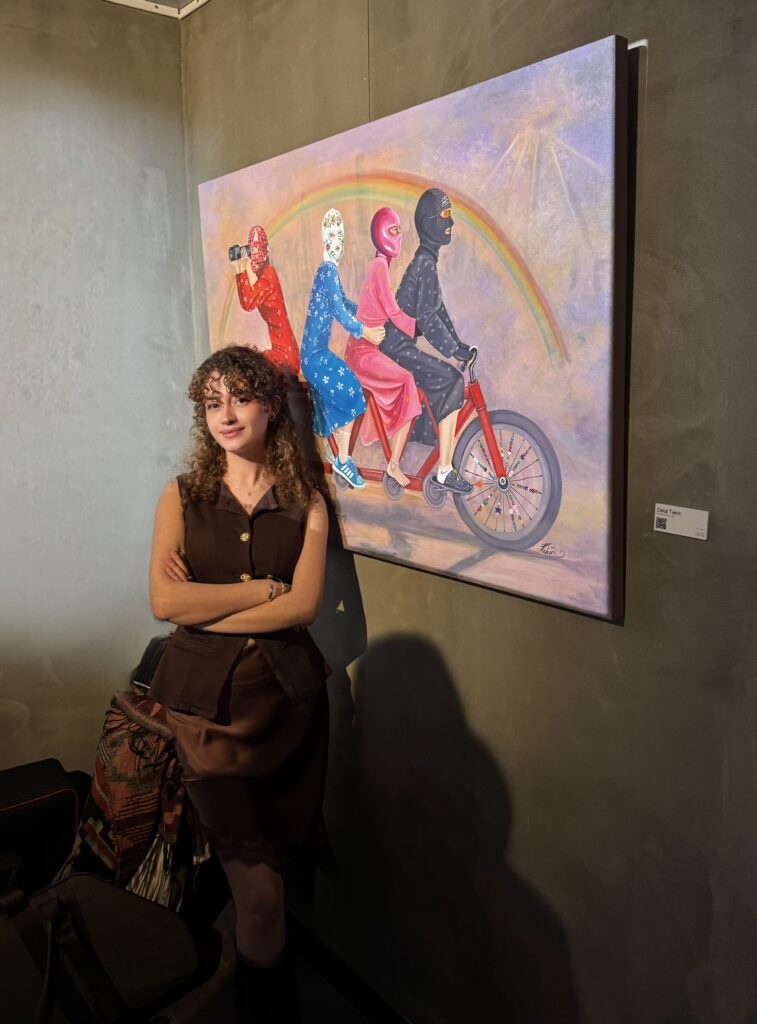
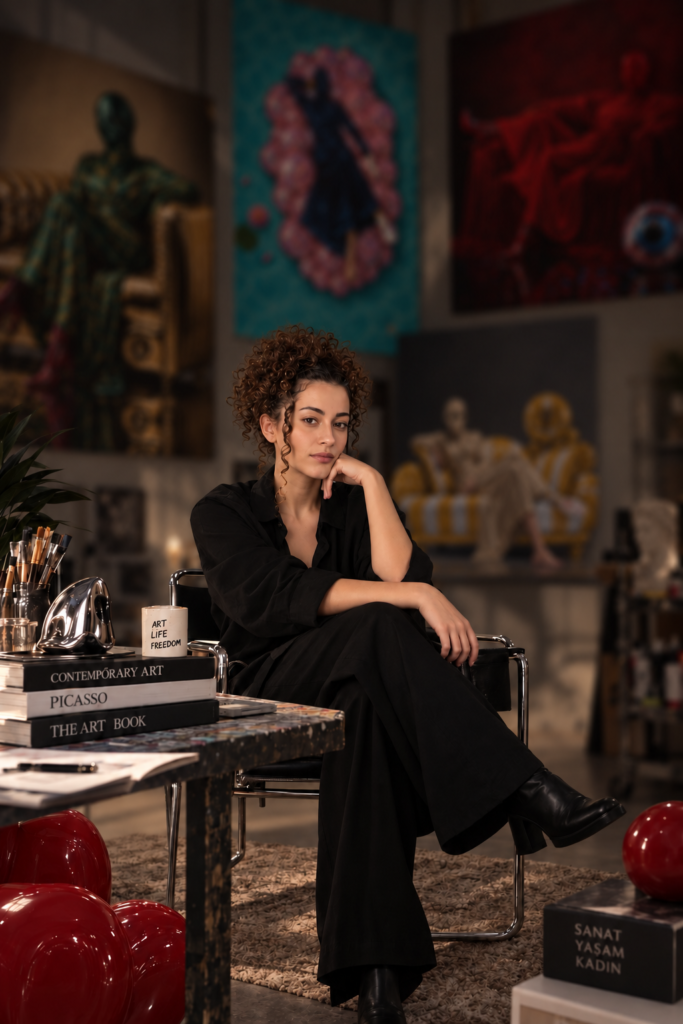
Delal Tekin. From the artist’s archive.
4. The face is one of the most powerful elements used to identify a person in the history of painting. In your works, however, the visibility of the face changes in different ways. How did the decision to withdraw the face from the image emerge, and has this choice taken on new meanings for you over time?
The reason I remove the face from my figures is that I want every person to derive a different meaning when looking at the figure. Basically, I want to present the thought “I am also here among this crowd of people, you are here too, and so are they” without restricting identity or creating a character.
Adding a face to the figure creates a limitation for people who find, or will find, something of themselves in my art. If my works had visible faces, they might not become visible in the way I want; they could be perceived as ordinary portraits. What I want to bring to life here is precisely for people to find a piece of themselves. I achieved this through the method I use in my works.
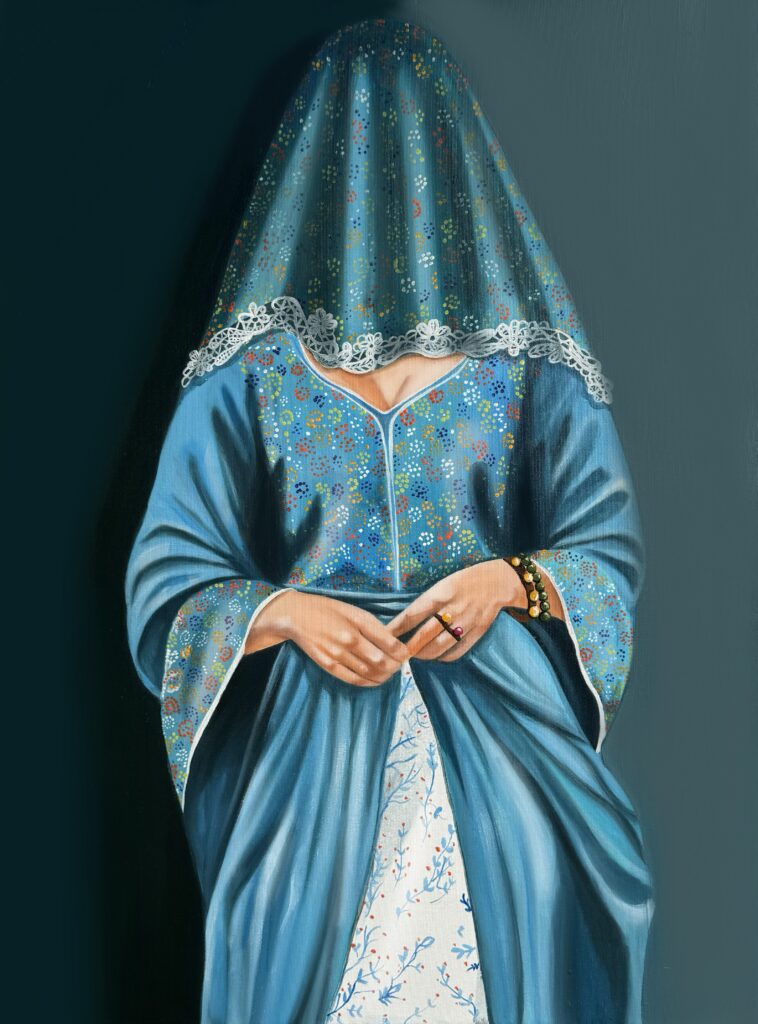
“Blue Serenade” 2024, Acrylic on canvas, 60 × 80 cm
5. Alongside the figures, fabric, coverings, patterns, botanical forms, and colours also become elements that carry the narrative of your paintings. When creating a work, how do you establish the relationship between these elements? For you, is a painting the visual counterpart of a predetermined idea, or is it a process that finds its own direction during its making?
For me, none of these elements is merely an ornament or decorative element on its own. The figure, fabric, covering, pattern, botanical forms, and colour are parts of a whole that complement one another. In particular, fabric and covering hide the figure’s body while at the same time making it more visible. Colour is often one of the first things that determines the emotion and atmosphere of the work. Botanical forms and patterns support this atmosphere and make the space in which the figure exists more layered.
When I begin a work, I often have a feeling, an image, or a relationship between colours in my mind; however, I do not see the painting entirely as the visual equivalent of a predetermined idea. Of course, I can make changes depending on the inspiration and emotional state of the moment. Even if I set out with an idea, the painting can find its own direction during production. While creating the work, the figure’s posture and attitude within the composition can sometimes lead me to change the elements and colours I add.
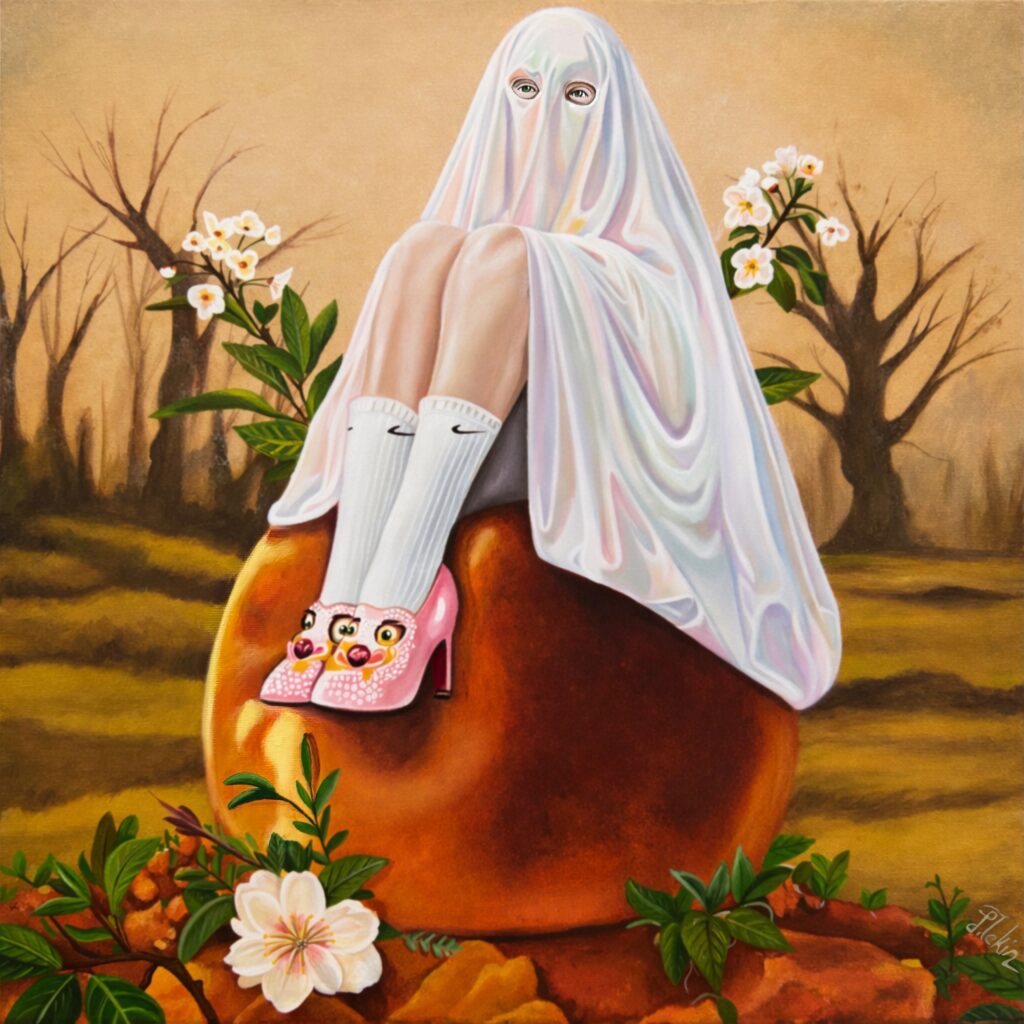
“After Autumn” 2026, Acrylic on canvas, 40 × 40 cm
6. Nature, and botanical forms in particular, appear repeatedly in your work. Does the relationship you establish with nature find its counterpart in your paintings primarily through form, colour, and texture, or is there another field of thought or emotion that you find reflected in nature itself?
There is a sentence I have used constantly before: “Nature is an endless source of inspiration for me.” Today, I transfer many things that exist in nature into my works, and I may add anything new that can be discovered in nature in the future; there is no limit to this for me. According to my wishes, I can also use an element that does not exist in nature but that I have been inspired by nature to create through my own imagination.
The counterpart of my relationship with nature in my imagination and paintings does not develop only through form, colour, and texture; the feelings and thoughts that nature leaves in me also have an important place. Therefore, rather than depicting nature exactly as it is, I use the traces it leaves in me within my own visual language. This is also why I sometimes use botanical forms around the figure, or as an element that covers or surrounds it. I want to create an encounter between the figure and nature.
Colour and texture also play an important role here. I am interested less in the colours I encounter in nature themselves than in the atmosphere they create. For me, nature is a source that nourishes my way of creating and the emotion of the painting.
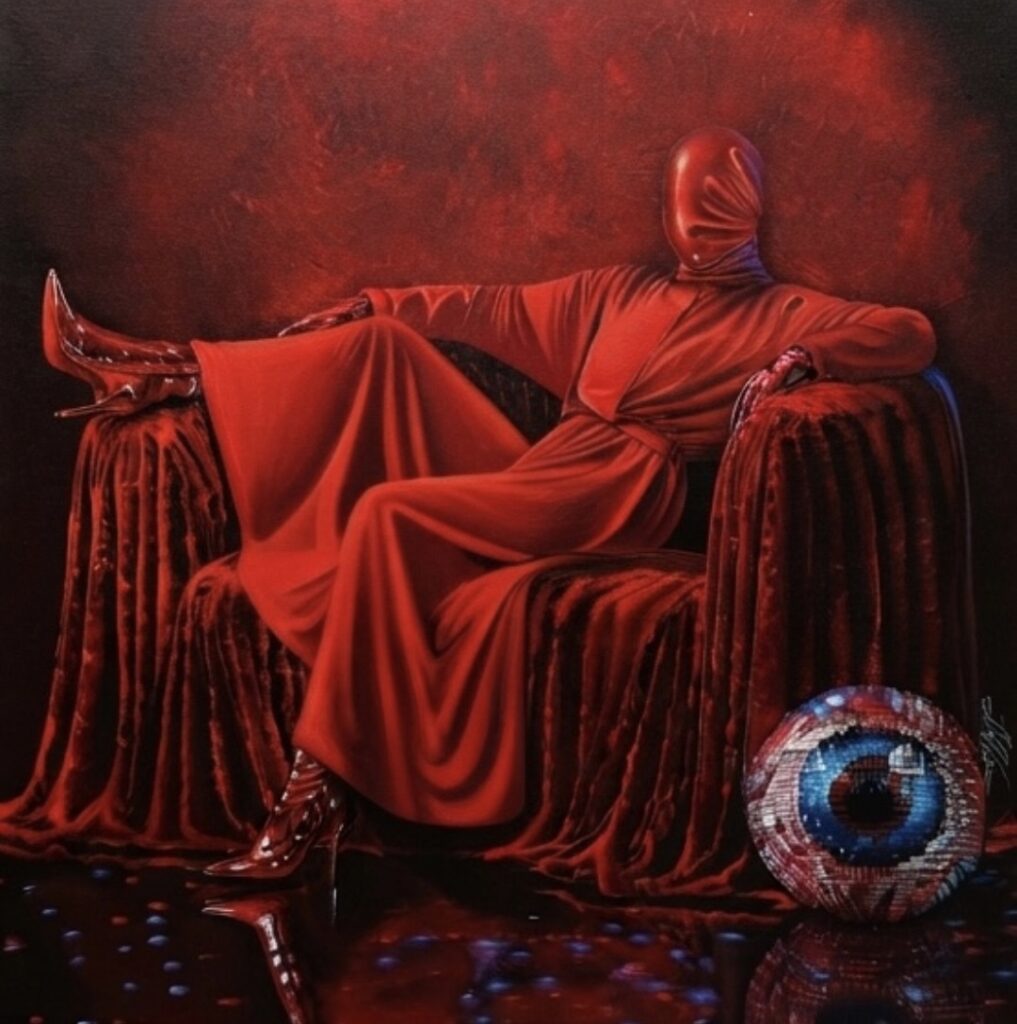
“Someone Is Watching Us” 2026, Acrylic on canvas, 50 × 50 cm
7. An artist’s visual world can be shaped not only by their own experiences, but also by the artists they look at and the works they encounter. Are there artists who have influenced your practice, inspired you, or led you to reconsider your work? Which names or artistic practices do you return to today?
Of course, there have been many artists and artistic practices that have influenced my work and made me rethink it. The way an artist uses material, approaches the figure, and looks at their own period and their own world is very nourishing for me.
I have always been particularly interested in the work of artists who focus on the figure and the body. Since my university years, I have been especially influenced by the use of light and shadow in Baroque art and by the treatment of fabrics, textures, and surfaces in the Rococo period. Although my own work does not formally resemble these periods, I draw nourishment from some of the expressive possibilities used by the masters of those periods.
For example, Caravaggio’s figures are works I have referred to and studied for a long time. In particular, the emergence of the figure from within the light, and the way light and shadow dramatically define the body, have been instructive for me. Rather than directly transferring these things into my own paintings, I am interested in how the methods they used might find a response within me. These encounters have opened up an important space for thought for me as I have developed my own figurative language and understanding of surface over time.
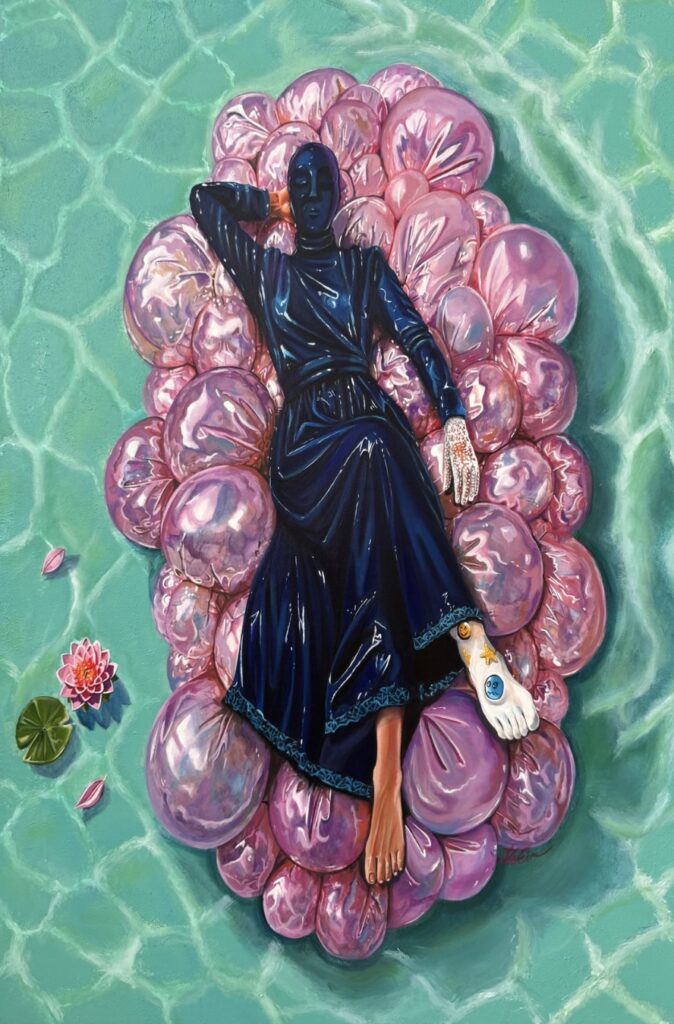
“I Made Everything Far Too Comfortable to Forget Myself” 2026, Acrylic on canvas, 60 × 90 cm
8. During an art education, contact with art history, different approaches to art, and the work of other artists can be as formative as the technical knowledge acquired. Was there an encounter during your education that changed the way you thought, pushed you in another direction, or made you think, “I should try this in my own practice”?
There were many encounters during my education that pushed me in different directions. Getting to know different periods and artists more closely, especially in art history classes, changed my way of looking at painting considerably. Previously, I looked at a work more through the resulting image and technique; over time, I began to realise how the use of light, colour, composition, material, and even the artistic understanding of the period affected the idea of the work.
But the most important gain for me during my education was beginning to see artists not simply as “people to be taken as examples,” but as different ways of thinking. When I encounter an artist, alongside the question “How did they do this?”, I now also think, “Why did they do it this way, and what can I learn from this for my own practice?” I think this perspective has been one of the things that has contributed most to me while creating my own technique and visual language today.
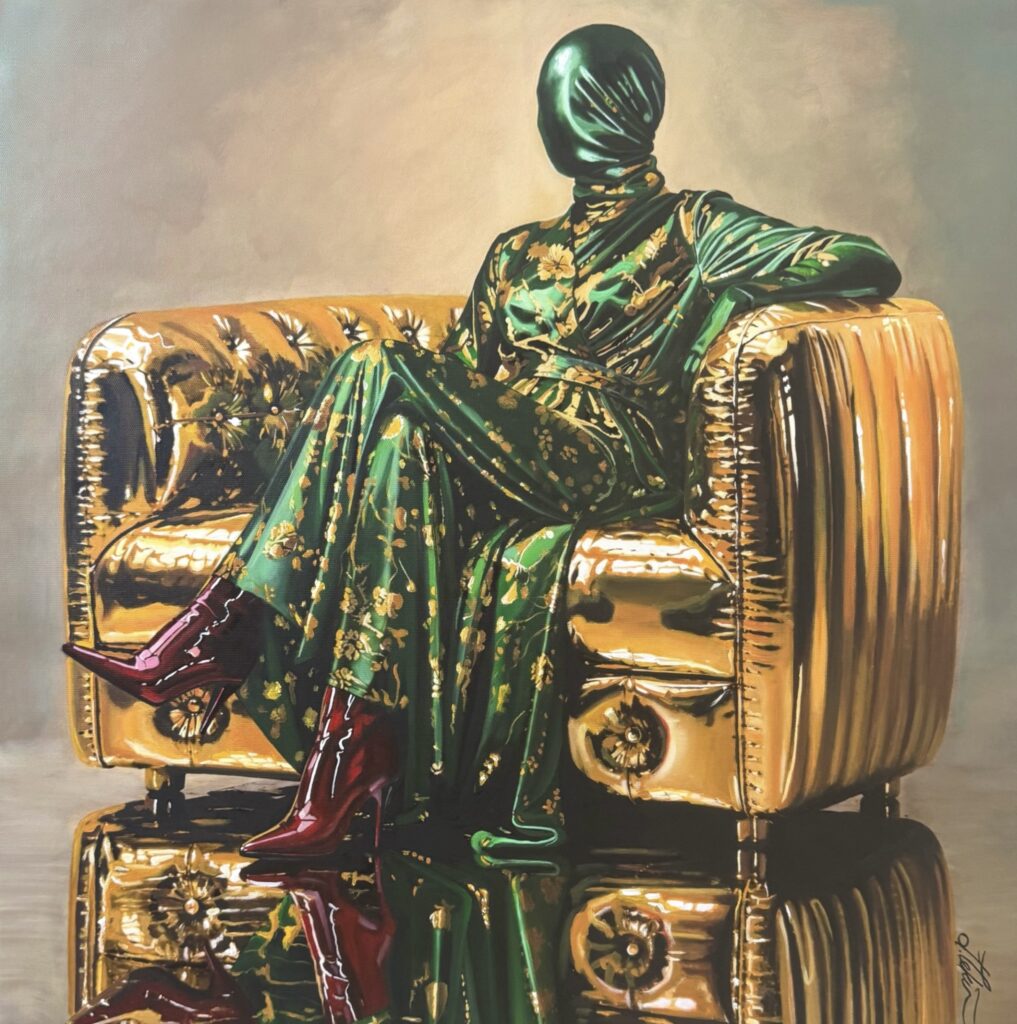
“Memories That Resist the Passage of Time and Cannot Be Contained Anywhere”
2026, Oil on canvas, 60 × 60 cm
9. The meaning an artist gives to a work and the meaning a viewer finds in it do not always have to be the same. How do you feel about your works becoming an independent story for the viewer? Could a viewer finding a meaning in a work that you never intended be part of the work’s completion for you?
When I give my own meaning to a work, of course I carry a starting point and an idea. But from the moment the work encounters the viewer, I think it no longer belongs only to me. Every viewer looks at the work through their own experience, memory, and emotions. Therefore, it is very valuable to me when a viewer finds a meaning that I had never thought of.
Sometimes listening to what a viewer sees in one of my works makes me look at that work again, because an unnoticed detail or a relationship I established while creating it may find a completely different response in another person. This shows that the work has created a life of its own.
I also think this is related to my withdrawing the face in my figures. Rather than telling a specific person or a single story, I want to leave a space where the viewer can place their own story. For this reason, I see the viewer finding a story independent of me in the work not as a deficiency, but rather as part of the work’s completion.
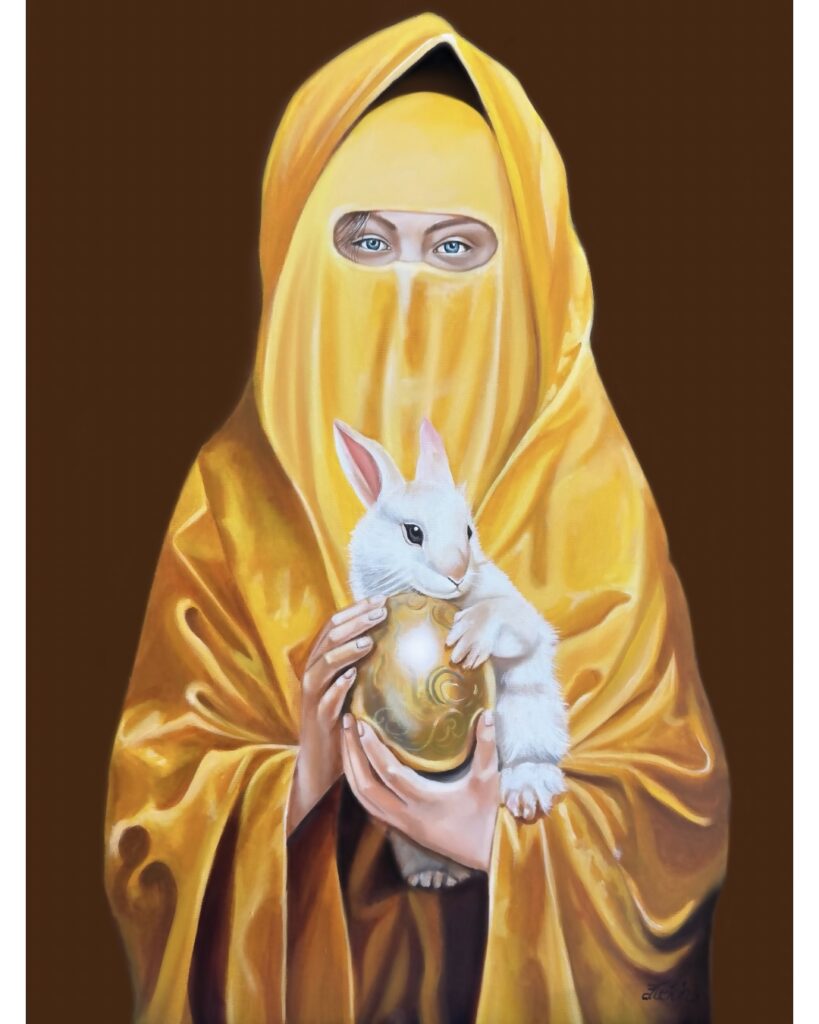
“Sacred Bearer” 2025, Acrylic on canvas, 60 × 80 cm
10. We see certain images, forms, or concerns recurring in your artistic practice over time. For an artist, repetition can mean not simply producing the same thing again, but looking at the same place from a different position each time. What do the recurring elements in your work tell you? Do you pursue them, or do they gradually carry you somewhere else?
The recurring figures, bodies, coverings, and botanical forms in my work do not actually mean repeating the same thing for me. On the contrary, I think some issues are still unfinished for me, and I continue to look at them again in different ways. Even when I use the same figure again, changes in its posture, the elements around it, its colours, its surface, or the form of the covering on it can create another meaning for me.
Sometimes I really do pursue them; an image forms in my mind and I continue to investigate it in different ways. Sometimes, during production, I realise that the same figure or the same issue is actually carrying me somewhere else. In particular, issues such as visibility, the body, identity, and the concealment of the face are not yet completed matters for me. I look at them from another perspective in every new work.
Therefore, I see repetition not as a cycle, but as a form of research. Although it may seem as if I am returning to the same place, I learn something different each time I return. Perhaps what changes over time is not the images, but the way I look at those images.
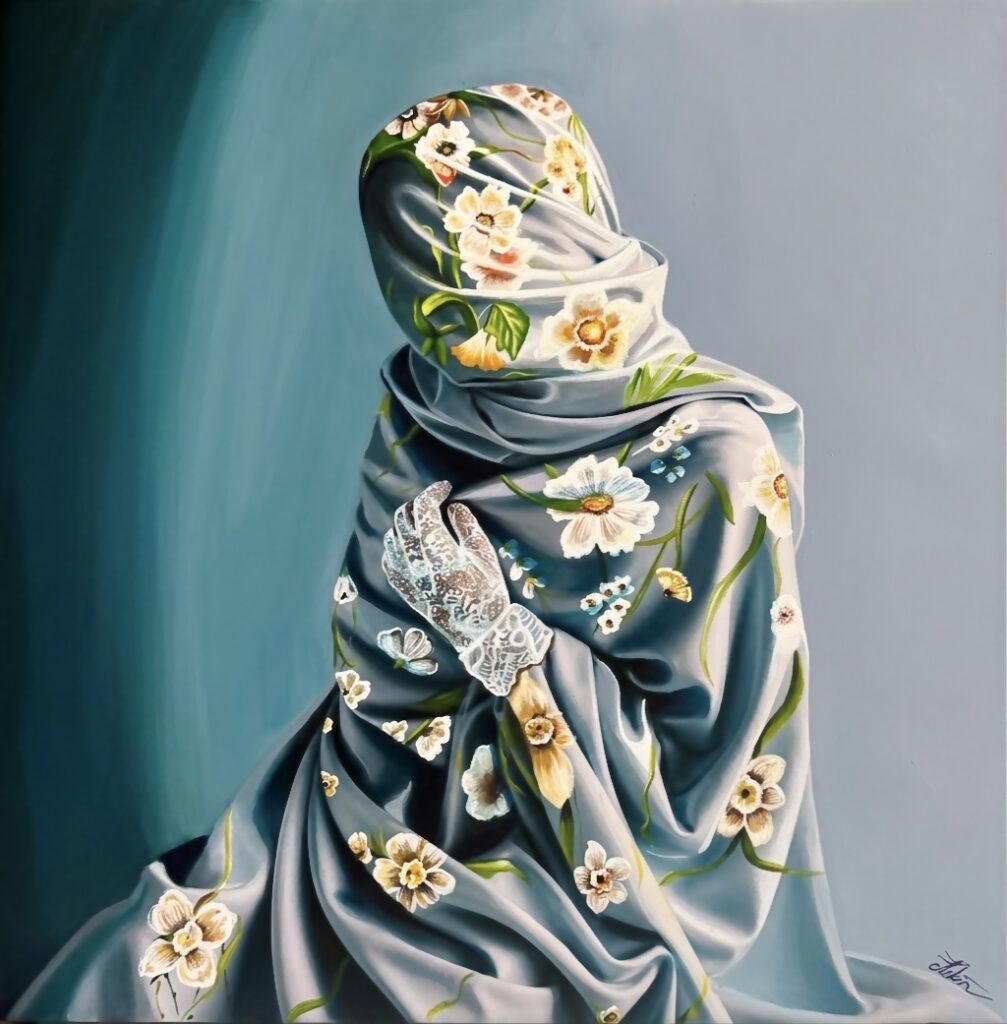
“The Manifestation of a Moment” 2026, Oil on canvas, 50 × 50 cm
11. Finding one’s own language as an artist is important, but so is having the courage to transform that language. Is there anything in your current practice that you want to change, disrupt, or push beyond its boundaries? When you think about your future work, in what direction would you like to surprise yourself?
For me, developing does not mean completely rejecting what I have done before; it means being able to carry it to another point. In my future works, while preserving my own language so that the viewer can say, “this is definitely their work,” I also want to create a transformation that makes them say, “but we have never seen this from them before.” I think I would most like to surprise myself when I am able to exceed my own limits through my own works.
Yes, when I feel that I have established my own language, I am also afraid of becoming too comfortable within that language. Therefore, what I want to change or push the boundaries of in my work today is not to completely abandon the figurative language I have created, but to experiment with it in different ways.
In particular, I want to take the relationship between the fabric, covering, surface, and botanical forms I use alongside the figure further, and work with different materials and different surfaces. I also want to question more deeply the figure’s position on the canvas, its scale, and its relationship with space. Sometimes I want to step outside the composition I am accustomed to and create spaces in which I can surprise myself while producing.
Zamansız Editör Kolektifi more from this author
Arts
TONY GATLIF: A CINEMA BEYOND BORDERS
5 September 2026
Arts
YAYOI KUSAMA:<div>A Trace Left Within Infinity</div>
28 August 2026
Interviews
ALAZ SAGLAM: In Pursuit of Color, Geometry, and the Inner World
22 August 2026
Latest
Art Review
Batik Aesthetics and the Intersections of Contemporary Art in Erhan Şanal’s Portraits
15 September 2026

Essays
Mental Essays–4: The Empire of Algorithms
4 September 2026
Arts
THE MEANING OF DESPAIR ACCORDING TO INGMAR BERGMAN
4 September 2026