

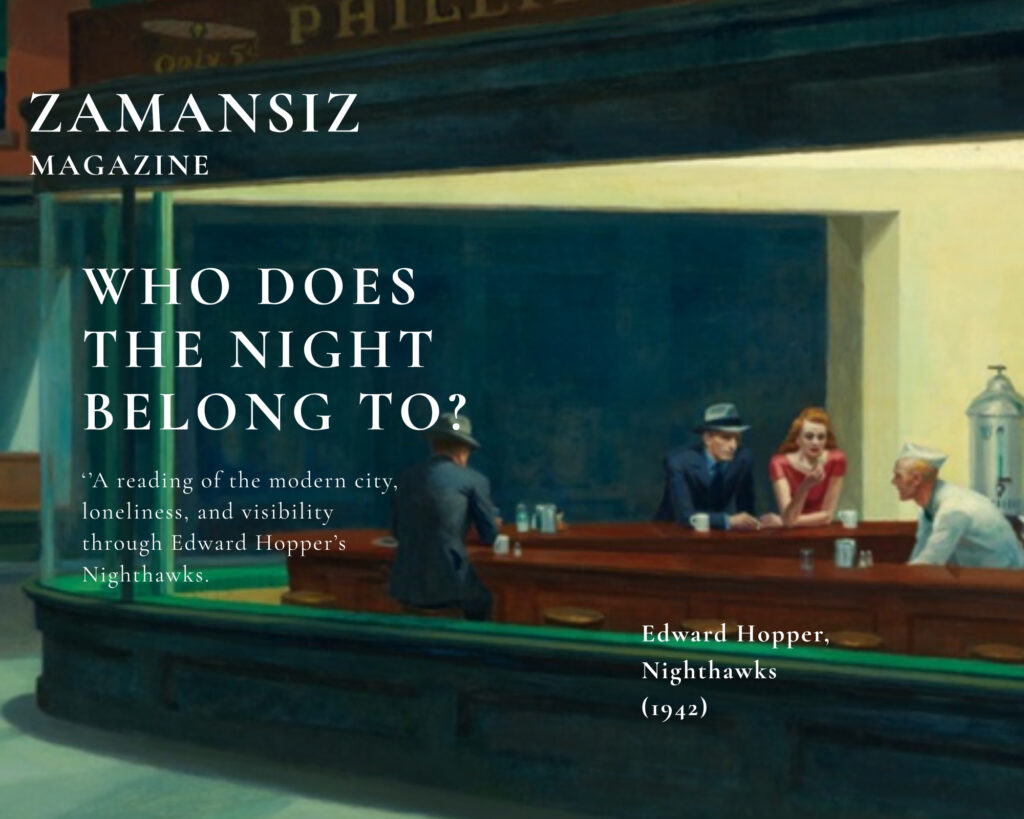
Who Does the Night Belong To?
A reading of modern urban life, loneliness, and visibility through Edward Hopper’s Nighthawks.
A painting’s resistance to time cannot be explained solely by its aesthetic power. Some works move beyond the period in which they were created and become open spaces in which each generation can find a meaning of its own. Edward Hopper’s 1942 painting Nighthawks is one of these works.
For years, this painting has been called “the picture of loneliness,” but it is actually concerned with a much more complex question: Does being together really mean being with one another?
The four figures Hopper brings together in a diner open at night do not appear physically far apart. Yet as we look more closely, what becomes apparent is not the physical distance between them, but their emotional disconnection. No one speaks. No one hurries. Time seems to have stopped for a few minutes.
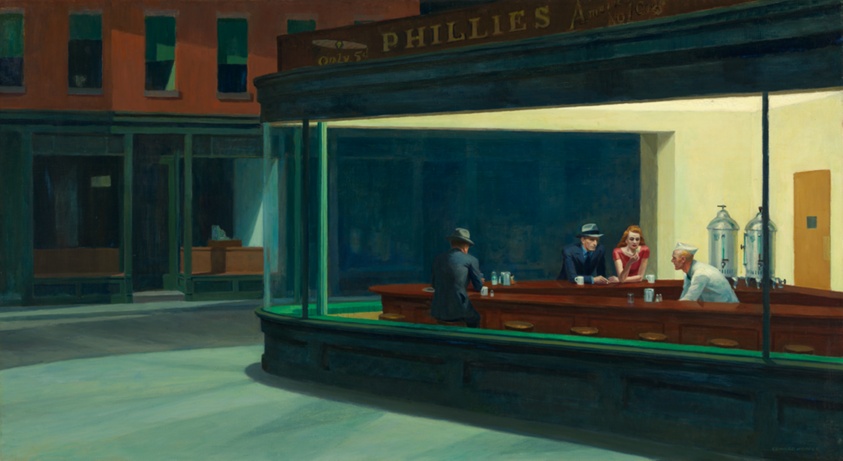
Edward Hopper, 1942, Nighthawks, oil on canvas.
Perhaps this is why Nighthawks reminds us less of America in the 1940s than of today’s cities. Modern urban life does not eliminate loneliness despite its crowds; it makes loneliness invisible.
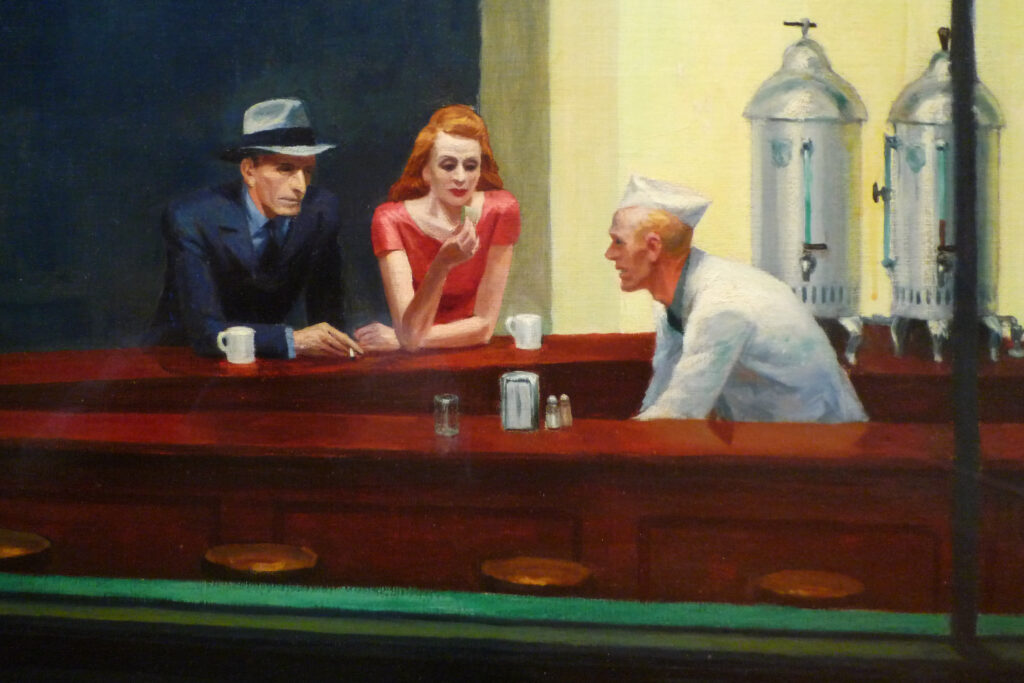
Detail, Edward Hopper, Nighthawks, 1942, oil on canvas.
One of the painting’s strongest elements is not the figures but the glass. The broad glass surface surrounding the diner makes the interior completely visible. Yet at the same time, it makes the space inaccessible. The viewer is a witness to the scene, but not a part of it. Hopper does not allow us to identify with the people inside; he leaves us outside.
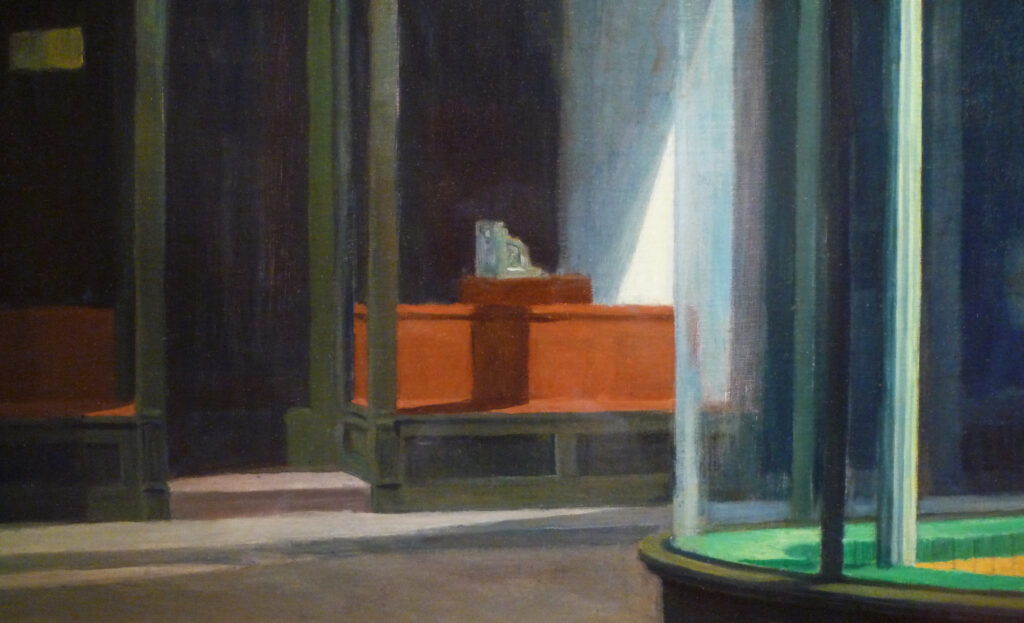
Detail, Edward Hopper, Nighthawks, 1942, oil on canvas.
Does our relationship with screens today produce a similar distance? We constantly see each other’s lives. But are we really witnessing one another? For precisely this reason, Nighthawks can be read not only as an important image in art history, but also as an important image of the digital age.
Nothing dramatic happens in Hopper’s painting. There is no murder, no fight, no clearly defined story. And yet the painting manages to hold the viewer before it for a long time. Because instead of giving an answer, it produces questions.
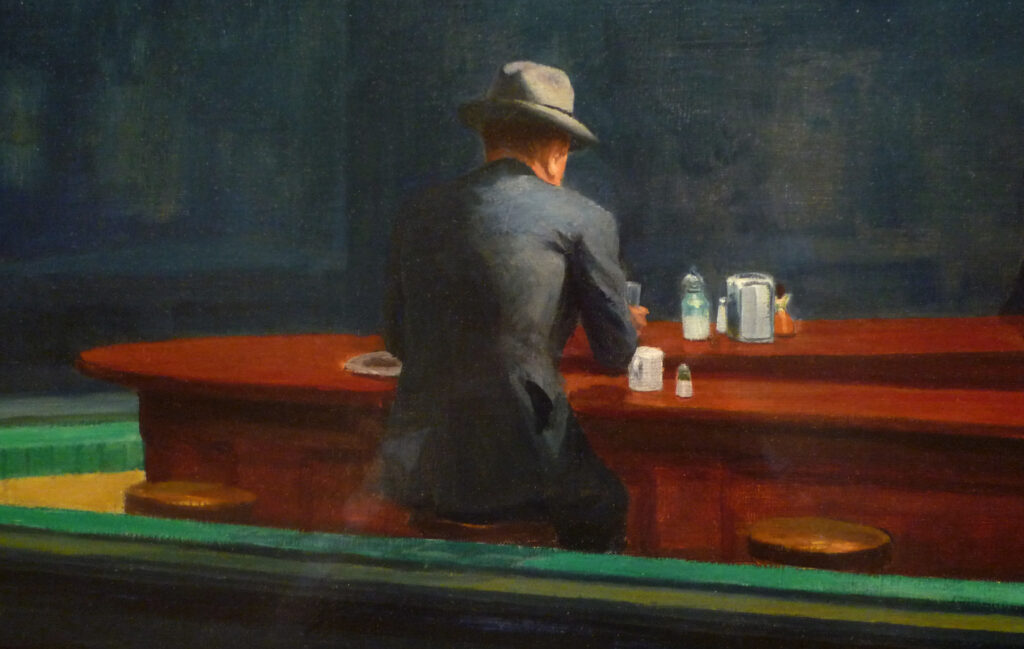
Detail, Edward Hopper, Nighthawks, 1942, oil on canvas.
Who are these people? Why are they here? Do they know one another? Or are they strangers sharing the same loneliness? Uncertainty becomes the work’s fundamental narrative device.
While much contemporary imagery of urban life is built around movement and speed, Hopper suggests the opposite. Silence can also be part of the narrative.
Perhaps this is why Nighthawks still looks so contemporary. The world has changed. Cities have grown. The night has become brighter than ever. Yet the invisible distances between people have not disappeared. Hopper’s painting does not belong only to the past. It belongs to a scene that is reproduced every night.
Nighthawks is one of the most reinterpreted works in art history. From David Lynch’s cinema to the photographs of Gregory Crewdson, from Banksy’s interventions to advertising and popular culture, the visual language of this painting has been reproduced across many fields. This is due not only to its aesthetic achievement, but also to its ability to construct a universal narrative about the loneliness of modern people.
Even today, Hopper’s painting remains a powerful point of reference for artists who want to explore urban life, waiting, and invisible distances.
Zamansız Note
“Good art does not represent time; it transcends it. Hopper’s Nighthawks has continued to ask the same question for more than seventy years: Do we really see one another within the crowd?”
The Zamansız app


Author
Gamze Kartal
Gamze Kartal is a London-based visual artist and a graduate of the Department of Art Education at Dicle University. Working across painting, collage, photography and digital manipulation, her practice explores the relationships between the body, memory, identity and perception. Using the image of the hand…
All articles (10) →Gamze Kartal more from this author

Latest
Arts & Culture
IOANNA KUCURADI:A LIFE DEVOTED TO PHILOSOPHY
5 October 2026
Arts
BREAKING FROM WITHIN: AN INTERVIEW WITH OMER EKEN
19 September 2026

Art Review
Batik Aesthetics and the Intersections of Contemporary Art in Erhan Şanal’s Portraits
15 September 2026