

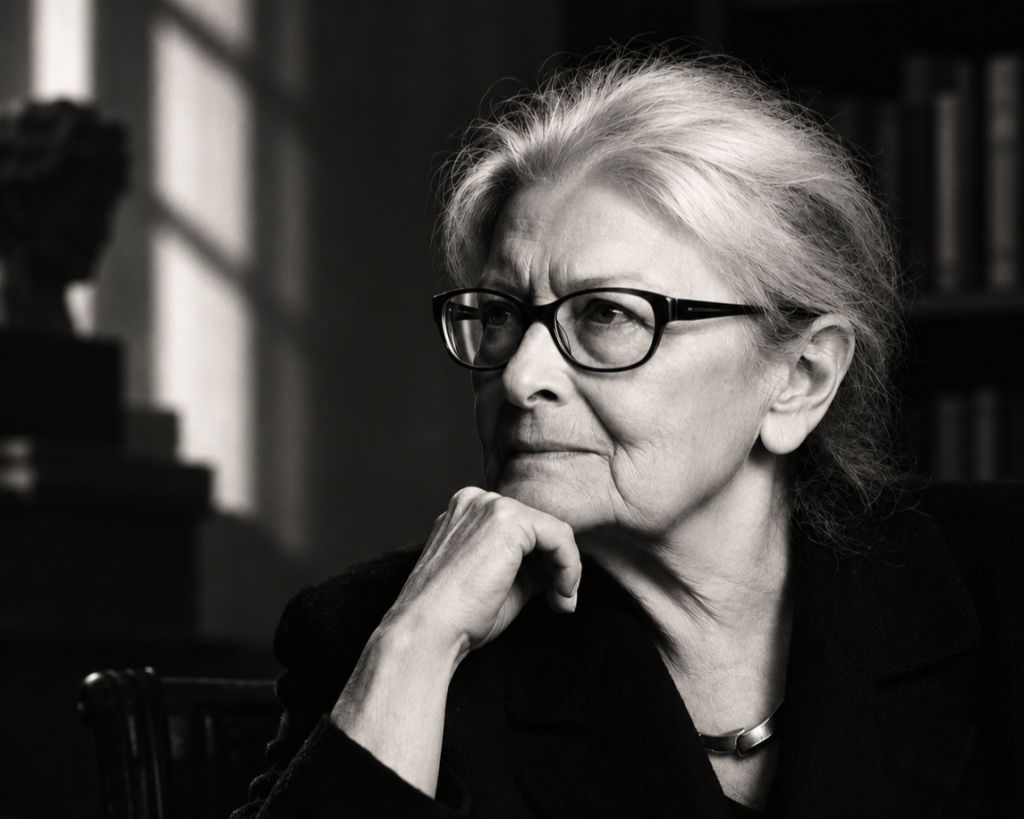
1936–2026
Ioanna Kucuradi’s life was a long intellectual journey in which she approached philosophy not merely as an academic discipline, but as a way of understanding the human being and the relationship between humanity and the world. Kuçuradi, who passed away on 2 October 2026, left behind more than six decades of philosophical work, numerous publications, generations of students, and a significant intellectual legacy in the fields of human rights, ethics, and values.
Born in Istanbul in 1936, Kuçuradi graduated from the Department of Philosophy at Istanbul University in 1959 and completed her doctoral studies in 1965. She spent a significant part of her academic career at Hacettepe University. In 1969, she founded the Department of Philosophy at Hacettepe University and served as its head for many years. Through her teaching, research, and the students she mentored, she made significant contributions to the development of philosophy education in Turkey.
At the centre of Kucuradi’s thought were the human being, values, and ethics. How a person, an action, or a situation should be evaluated; according to which criteria values should be considered; and how ethical questions should be approached were among the fundamental concerns of her work. For Kucuradi, who did not regard philosophy as a field of thought detached from life, ethics, values, and human rights were subjects with direct relevance to everyday life. Human relationships, the decisions people make, and the ways in which they evaluate the world were integral parts of this perspective.
This intellectual approach also led Kucuradi towards the field of human rights. In her work on human rights, she established connections between philosophical thought and legal and social questions. Rather than considering human rights solely within the framework of legal regulations, she developed an approach in which they were understood in relation to human value and dignity. In doing so, she established a strong connection between the conceptual world of philosophy and the concrete issues of society.
Kucuradi’s influence extended beyond the boundaries of her academic work. She served for many years as President of the Philosophical Society of Turkey, undertook various responsibilities within international philosophical organisations, and contributed to UNESCO’s work in the fields of philosophy and human rights. She also played a role in the process that led to the establishment of World Philosophy Day. In this respect, her life demonstrated how philosophy could move beyond the walls of the university and reach a broader intellectual and cultural sphere.
Her books also reflected this broad field of thought. Human and His Values, Ethics, Human Rights: Concepts and Problems, Looking at Art through Philosophy, Nietzsche and the Human Being, and Schopenhauer and the Human Being are among the works that stand out in understanding Kucuradi’s intellectual world. She also contributed to philosophical thought through her translations, bringing some of Kant’s major works into Turkish.
One of the most distinctive aspects of Kucuradi’s thought was that she did not distance philosophy from the real questions of life. For her, thinking about the human being, values, ethics, and rights did not simply mean engaging in an academic debate. These concepts extended into many areas of life—from how one looks at another person to how one makes decisions in the face of an event and how social issues are evaluated.
For this reason, it is not sufficient to assess Ioanna Kucuradi’s legacy solely through her published books. The department she founded, the courses she taught, the students she mentored, the institutions in which she took part, her translations, and the work she sustained over many years are all interconnected parts of this legacy. Her dedication to philosophy made her an important thinker not only for her own generation but also for generations to come.
Ioanna Kucuradi’s life came to an end in 2026. Yet what she left behind is not merely a body of published work, but a long academic and intellectual legacy grounded in thinking, questioning, and understanding the human being. Her work on humanity, values, ethics, and human rights continues to engage with questions that remain relevant today.
Looking at her life, it becomes clear that philosophy was, for Kucuradi, not merely a field of study, but also a sustained effort to understand the world and the human being.
The Zamansız app


Zamansız Editör Kolektifi more from this author
Arts
BREAKING FROM WITHIN: AN INTERVIEW WITH OMER EKEN
19 September 2026

Arts
FROM WITHIN THE INVISIBLE : AN INTERVIEW WITH DELAL TEKIN
7 September 2026
Arts
TONY GATLIF: A CINEMA BEYOND BORDERS
5 September 2026
Latest
Arts
IN THE FOOTSTEPS OF ART: MEMORY, NATURE, ROOTS AND TRANSFORMATION AN INTERVIEW WITH FIRAT BINGOL
1 October 2026

Art Review
Batik Aesthetics and the Intersections of Contemporary Art in Erhan Şanal’s Portraits
15 September 2026

Essays
Mental Essays–4: The Empire of Algorithms
4 September 2026